7 Things You Didn’t Know About Dumfries and Galloway
Posted on 08-10-25, updated on 23-01-26By: Claire S. | 9 minute read

Tucked away in the south-west corner of Scotland, Dumfries and Galloway is one of the nation’s best-kept secrets, a place where dramatic coastlines meet rolling hills, ancient castles, and untold legends. While many rush to Scotland’s better-known landmarks, those who venture here discover a region brimming with history, creativity, and hidden charm.
It’s also the perfect destination for a relaxing countryside escape, with a wide range of holiday cottages in Scotland offering cosy bases from which to explore. From traditional stone retreats to seaside hideaways, there are plenty of cottages in Dumfries and Galloway where you can unwind after a day of discovery and soak in the tranquillity of this unspoilt region.
From literary legacies and mysterious standing stones to tranquil lochs and thriving wildlife, Dumfries and Galloway offers a taste of hidden Scotland at its most authentic. Whether you’re a culture lover, nature enthusiast, or simply curious to explore beyond the beaten path, this corner of the country promises stories and surprises around every turn.
Here are seven fascinating Dumfries and Galloway facts that will inspire your next travel adventure.

Did You Know Scotland’s Oldest Working Theatre Is in Dumfries?
Nestled in the heart of Dumfries, the Theatre Royal Dumfries holds a remarkable place in Scottish cultural history. Opened in 1792, it is officially the oldest theatre in Scotland still entertaining audiences today. Built by subscription and supported by local luminaries, including the poet Robert Burns, who was one of its earliest patrons, the theatre has been a cornerstone of the region’s creative life for over two centuries.
Over the years, the Theatre Royal has welcomed everything from classic plays and touring opera companies to community performances and comedy nights. Despite several renovations, its charm and Georgian character remain intact, offering visitors a rare glimpse into Scotland’s theatrical past while embracing modern production values. As one of the standout Dumfries attractions, it continues to nurture the local arts scene and provide a stage for emerging talent.
What’s it like to visit today?
Today, stepping inside the Theatre Royal Dumfries feels like travelling through time. The intimate auditorium, with its ornate detailing and warm atmosphere, makes every performance a personal experience. Visitors can enjoy a diverse calendar of shows, from contemporary drama and live music to family-friendly pantomimes. The theatre also runs guided tours, where guests can explore behind the scenes, visit the dressing rooms, and learn more about its fascinating 18th-century origins. Whether you’re a theatre enthusiast or simply exploring Dumfries, the Theatre Royal offers a captivating blend of heritage, artistry, and community spirit.

Robert Burns Birthplace
Why Is Dumfries Known as the Last Home of Robert Burns?
The market town of Dumfries holds a special place in Scottish literary history as the last home of Robert Burns, Scotland’s national bard. After moving there in 1791, Burns spent his final years working as an excise officer while continuing to write some of his most enduring poetry. His time in Dumfries was one of both creativity and challenge, a period that deepened his connection to everyday Scottish life and shaped much of his later work.
Today, you can explore several important sites that tell the story of Robert Burns in Dumfries. The Burns House, where he lived with his family, has been preserved as a museum filled with personal belongings, manuscripts, and exhibits that offer insight into his daily routines and passions. Just a short walk away is the Globe Inn, one of Burns’s favourite haunts, where he would relax, socialise, and compose verses that still echo through Scotland’s cultural memory. His final resting place lies nearby in St Michael’s Churchyard, marked by an elegant mausoleum that attracts admirers from around the world.
Dumfries celebrates Burns not just as a poet, but as a man of the people, one whose words captured the humour, heart, and humanity of Scotland. For lovers of literature, the town offers a living connection to one of the most celebrated Scottish poets in history.
Can you really sit where Burns sat?
Absolutely, and there’s no better place to do so than the historic Globe Inn. Step inside and you’ll find 18th-century charm perfectly preserved, from low-beamed ceilings to walls lined with Burns memorabilia. Many choose to dine or raise a glass in the very room where Burns once entertained friends, making it a truly atmospheric stop on any Burns-inspired journey through Dumfries.

What’s So Special About the Galloway Forest Dark Sky Park?
Deep in the heart of southwest Scotland lies Galloway Forest Park, a vast landscape of hills, lochs, and woodlands that has earned global recognition as one of the best places for stargazing. Designated as the UK’s first official Dark Sky Park in 2009, and one of the first in Europe, it’s an area where artificial light is kept to a minimum, allowing the night sky to shine in all its natural glory. This prestigious status means ypu can witness cosmic sights with astonishing clarity, making it a must-see destination for anyone fascinated by the wonders of the universe.
Covering more than 300 square miles, Galloway Forest Park offers countless opportunities for outdoor adventure by day and stargazing in Dumfries and Galloway by night. The park’s three visitor centres, Kirroughtree, Clatteringshaws, and Glentrool, all provide access to prime viewing spots, where you can gaze upon thousands of stars visible to the naked eye. The best time to visit is during autumn and winter, when long, crisp nights and low humidity create the perfect conditions for observing the heavens.
What might you see on a clear night?
On an ideal night, the Dark Sky Park Scotland experience is nothing short of magical. The shimmering Milky Way stretches across the sky, while meteor showers leave trails of light overhead. Depending on the season, you may spot planets like Venus, Jupiter, and Saturn, even the occasional aurora borealis if conditions are right. For a deeper dive into the cosmos, head to the nearby Scottish Dark Sky Observatory or join one of the park’s organised stargazing events, where experts guide you through constellations and celestial stories. Whether you’re an amateur astronomer or a romantic dreamer, Galloway Forest Park promises a night sky you’ll never forget.

Is There Really a ‘Scottish Riviera’ Here?
It might surprise some visitors to learn that Scotland has its own “Riviera”, and it’s found along the Dumfries and Galloway coast. The Scottish Riviera, as locals affectionately call it, stretches along the stunning Solway Coast, where sheltered coves, palm-like cabbage trees, and sparkling waters create a uniquely mild and peaceful setting. Thanks to the Gulf Stream’s warming influence, this corner of southwest Scotland enjoys a surprisingly temperate microclimate, with colourful seaside villages that wouldn’t look out of place in the Mediterranean.
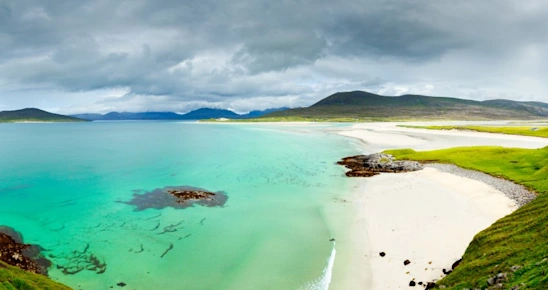
Charming spots such as Kippford and Rockcliffe offer a laid-back coastal vibe, with harbourside walks, local seafood, and views across to Cumbria. Further west, Port Logan boasts one of the most picturesque settings on the Scottish mainland, where sweeping sands meet wild cliffs and turquoise seas. This lesser-known coastline is a haven for walkers, kayakers, and anyone searching for secret beaches in Scotland that remain blissfully uncrowded.
Which beaches are worth a detour?
For a peaceful escape, head to Sandyhills Bay, where broad sands and shallow waters make it ideal for families and sunset strolls. Carrick Shore is another gem, loved by locals for its rock pools and quiet beauty, especially in the evening light. Those seeking solitude should explore Monreith Bay or Ardwell Bay, two secluded spots perfect for a picnic and a paddle. The best times to visit are spring through early autumn, when the coastal paths are alive with wildflowers and the calm waters invite exploration by kayak or foot.

How Did an Artists’ Colony Shape Kirkcudbright’s Colourful Past?
Nestled on the banks of the River Dee, the picturesque harbour town of Kirkcudbright has long been celebrated as one of the most creative Scottish art towns. Its story truly came to life in the late 19th century, when a group of painters, writers, and makers gathered here to form what became known as the Kirkcudbright Artists’ Colony. Drawn by the town’s soft coastal light, peaceful atmosphere, and affordable living, these artists transformed Kirkcudbright into a hub of imagination and innovation.
Among the most famous figures was Jessie M. King, the acclaimed illustrator and designer whose Art Nouveau style brought international attention to Kirkcudbright. Other notable members included E.A. Hornel and Charles Oppenheimer, who captured the area’s vibrant colours and community life in their work. Together, they helped shape the rich Kirkcudbright history that continues to influence local culture today.
Modern-day Kirkcudbright remains alive with creativity. The town hosts annual arts and crafts trails, lively festivals, and exhibitions that celebrate both its historic masters and contemporary talent. Artists still live and work here, maintaining the spirit of collaboration and inspiration that first defined the colony more than a century ago.
Can you still see their work?
Yes, and there’s no better place to start than the Kirkcudbright Galleries, which houses an impressive collection of art linked to the colony. You can also follow the town’s art trails, exploring studios, murals, and heritage landmarks that bring Kirkcudbright’s colourful artistic past to life.

What Role Did Dumfries and Galloway Play in Wartime Secrets?
During the Second World War, the quiet countryside of Dumfries and Galloway became an unlikely stage for some of wartime Scotland’s most strategic, and secret, operations. Hidden among the rolling hills and rugged coastline, the region played a vital role in training, logistics, and naval operations that supported the Allied war effort.
One of the most important sites was RAF Dumfries, a key airfield used for training bomber crews and air gunners before they were sent overseas. Its runways and hangars buzzed with activity, forming part of a network of bases that helped shape Britain’s aerial defences. Meanwhile, along the coast, Loch Ryan became a crucial naval hub, serving as a deep-water anchorage for flying boats, troop carriers, and later, the surrender of German U-boats at the war’s end. Together, these facilities made Dumfries and Galloway an unsung but essential contributor to the complex web of WW2 secrets in Scotland.
Beyond its official bases, the region also hosted covert training exercises and experimental operations, taking advantage of its remote landscapes and sparse population to maintain discretion.
Is there anything left to explore?
Yes, history enthusiasts can still uncover traces of this hidden past. The Dumfries and Galloway Aviation Museum, located on the former RAF Dumfries site, preserves aircraft, artefacts, and personal stories from the era. Across the region, remnants of control towers, bunkers, and runways stand as quiet witnesses to a time when Dumfries and Galloway helped guard Britain from the shadows.

Why Is Dumfries and Galloway a Hotspot for Ancient History?
For those fascinated by Scotland’s distant past, few places rival Dumfries and Galloway. This quietly dramatic corner of the country is home to an extraordinary concentration of prehistoric landmarks, a landscape where every hill and glen seems to whisper stories from thousands of years ago. From Neolithic tombs to mysterious stone circles in Scotland, the region offers a rare glimpse into the lives, beliefs, and craftsmanship of early settlers.
Among the most impressive sites are Cairnholy I and II, ancient burial chambers perched above Wigtown Bay. Dating back over 5,000 years, these megalithic monuments are thought to have been sacred places of ritual and remembrance. Elsewhere, you can discover the Twelve Apostles Stone Circle near Dumfries, one of the largest in Britain, as well as Iron Age forts and standing stones scattered across the countryside. Together, these ancient sites in Dumfries form a remarkable open-air museum, revealing how early communities farmed the land, worshipped their gods, and connected with the heavens.
How accessible are these ancient sites?
Many of these historic treasures are surprisingly easy to reach. Sites like Cairnholy can be accessed by car followed by a short walk, while others are signposted along scenic country lanes and walking trails. The region also offers guided tours and interpretation boards that help you uncover the meaning behind each site. Whether you’re a casual visitor or a dedicated history enthusiast, exploring Dumfries and Galloway’s ancient landscapes is an unforgettable journey into Scotland’s earliest stories.
Ready to Discover the Hidden Side of Dumfries and Galloway?
If you’re longing to explore somewhere rich in beauty, heritage, and heart, it’s time to visit Dumfries and Galloway. Beyond its rolling hills and rugged coastline lies a region filled with stories, from ancient monuments and artistic legacies to secret beaches and star-studded skies. Every corner reveals something unexpected, whether you’re wandering through historic towns or gazing at the night sky over Galloway Forest. So take the slower road, embrace curiosity, and let this captivating region surprise you. With a few insider Dumfries travel tips, your journey here will be nothing short of unforgettable.
About Us
cottages.com is your go-to destination for an extensive selection of memorable cottage holidays. With a wealth of experience spanning over 45 years, we boast a portfolio of over 18,000 holiday homes spread across the UK, catering to every budget. We're committed to maintaining a high standard of service to our customers by abiding by ABTA's Code of Conduct Our excellent Trustpilot rating reflects the high level of customer satisfaction we strive for. We believe in keeping things simple, so you can focus on making lasting memories with your loved ones from the moment you book with us.